The CPC Newsfeed includes industry and safety news, product features, new products and product videos.
Newsfeed Topics
In depth articles on MUTCD compliancy, low cost safety measures, explanation of products, product introductions and overviews, industry insights and more.
Warning: include(): open_basedir restriction in effect. File(/var/www/vhosts/cpcsigns.com/httpdocs/simpleblog/styles/css_front_end.php) is not within the allowed path(s): (/var/www/vhosts/oldsite.cpcsigns.com/:/tmp/) in /var/www/vhosts/oldsite.cpcsigns.com/httpdocs/simpleblog/blog.php on line 247
Warning: include(/var/www/vhosts/cpcsigns.com/httpdocs/simpleblog/styles/css_front_end.php): Failed to open stream: Operation not permitted in /var/www/vhosts/oldsite.cpcsigns.com/httpdocs/simpleblog/blog.php on line 247
Warning: include(): Failed opening '/var/www/vhosts/cpcsigns.com/httpdocs/simpleblog/styles/css_front_end.php' for inclusion (include_path='.:/opt/plesk/php/8.2/share/pear') in /var/www/vhosts/oldsite.cpcsigns.com/httpdocs/simpleblog/blog.php on line 247
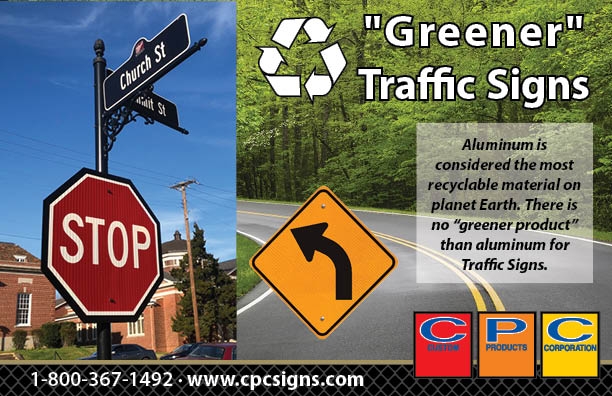
There is no “greener product” than aluminum for Traffic Signs.
Plastic signs have entered the traffic sign market multiple times over the years.
While recyling plastic for the use in making traffic signs seems like a good idea, plastics have issues that aluminum does not:
Plactic and PVC signs can be prone to fading or cracking in extreme weather.
Once the plastic sign is at the end of its life, it no longer becomes easy to recycle it again and ends up in landfills or burned.
Plastics are known to release toxins, become microplastics and enter out ground water endangering all life and our ecosystem.
Until the 1970’s, steel and wood were the primary substrates for traffic signs.
Aluminum was used during this time as well, but it was “airplane grade” (6061 alloy) which was way too expensive and unnecessary for a traffic sign.
Advancements in the aluminum industry led to new alloys in the 1970’s and 80’s, so aluminum quickly replaced steel and wood.
Since the 1980’s there have been multiple substrates designed to replace aluminum as the traffic sign substrate – fiberglass, Lexan, ACM, recycled plastic – and all have failed miserably. Aluminum has stood the test of time better than any other substrate.
Aluminum is considered the most recyclable material on planet Earth, so nothing is a “greener product”.
Custom Products Corporation has decades of experience providing high-quality traffic sign mounting hardware to client all across the U.S. Whether you’re adding a new sign to your community streets or replacing an old sign, our mounting hardware will keep it stable and allow it to stand strong for years to come. We carry round and U-channel posts, brackets, breakaway systems, and all the tools you’ll need to get the job done.
CPC Signs maintains a large inventory of post and overhead brackets. Chances are, we have the items you need in stock and can ship them within 24 hours of the order being placed.
We have what you need, when you need it!
Call 1-800-367-1492 for a customized quote.
Best Value: This CPC brand heavy-duty bracket offers the lowest price combined with the heavy-duty quality, when compared to the light and medium duty brackets available.
MUTCD compliant product and knowledge is a Custom Products customer benefit you can count on to save you time and money.
Overhead Sign Mounting: Did You Know?
The Manual for Uniform Traffic Control Devices (MUTCD) Section 2A.17 states:
Overhead signs should be used on freeways and expressways, at locations where some degree of lane-use control is desirable, and at locations where space is not available at the roadside.
The operational requirements of the present highway system are such that overhead signs have value at many locations.
Over-crossing structures may be used to support overhead signs.
Under some circumstances, the use of over-crossing structures as sign supports might be the only practical solution that will provide adequate viewing distance.
The use of such structures as sign supports might eliminate the need for the foundations and sign supports along the roadside.
Overhead signs shall provide a vertical clearance of not less than 17 feet to...